

| What’s the Distinction Between a Heat Switch and a Chilly switch?
A heat switch ensures a clean name switch between the preliminary agent and the receiving agent, full with introductions and context, whereas a chilly switch is when the preliminary agent transfers the shopper to a different agent with out warning. |
Buyer expertise 101: Don’t make clients repeat themselves.
Give it some thought: If you want buyer help, do you need to clarify your subject to an agent simply to repeat the identical story to another person after being transferred? An distinctive buyer expertise (CX) is tied to each touchpoint throughout the shopper journey. By merely warm-transferring a caller, you’ll be able to add that little “further” in a unprecedented buyer expertise by merely warm-transferring a caller.
Our information breaks down the chilly switch vs. heat switch processes intimately, together with the examples, execs and cons, key variations, and which follow is extra helpful to clients and companies alike.
What Is a Chilly Switch?
A chilly switch, additionally referred to as a blind switch, is when the preliminary agent connects the shopper to a different agent or division with out speaking buyer context or question particulars. The receiving agent has little or no details about the incoming name or what the shopper wants. The shopper should clarify their subject or motive for reaching out once more, resulting in a irritating buyer expertise.
| When to make use of it: It’s a finest follow to make use of heat transfers at any time when doable. Nevertheless, you should utilize a chilly switch in these conditions:
– When a buyer asks for a selected agent or division |
Chilly switch instance
Right here’s an instance of a chilly switch trade in motion.
- Customer support agent: “Thanks for calling [Company Name]. My title is David. How can I show you how to at the moment?”
- Buyer: “Hello David, I’m having hassle logging in to my account. I preserve getting an error message.”
- Customer support agent: “I perceive, login points may be irritating. Could I’ve your title and account quantity?
- Buyer: “Jenny Smith. Account quantity 8675309.”
- Customer support agent: “Thanks, Jenny. It appears to be like like a number of Platinum accounts are getting the identical error messages. Could I switch you to our technical help group who can help you additional?”
- Buyer: “Certain, thanks.”
- (Temporary maintain music)
- Technical help agent: “Technical help, that is Tommy. How might I help you?”
- (Buyer sighs)
- Buyer: “Ugh, okay. Like I mentioned, I preserve getting an error message after I attempt logging into my account.”
- Technical help agent: “Gotcha. Could I’ve your title and account quantity so I can have a look?”
This chilly switch interplay lacks constructive and proactive components that improve the shopper expertise. Although the decision heart agent is well mannered, they use impartial language that doesn’t supply reassurance to the shopper. The primary subject is that the shopper is transferred blindly to a brand new agent with out offering an introduction or context, affecting CX and probably harming your model fame.
Chilly switch execs and cons
Chilly transfers may be helpful for effectivity, however solely use them strategically to keep away from harming the shopper expertise. Think about heat transfers or different options at any time when doable.
| Chilly Switch Execs | Chilly Switch Cons |
|---|---|
| Quicker name decision Improved agent effectivity Decreased prices |
Adverse buyer expertise Lack of context Decrease buyer satisfaction |
What Is a Heat Switch?
A heat switch refers back to the strategy of an preliminary agent offering the related data and context of a buyer interplay to a receiving agent earlier than handing off the shopper for additional help. Heat transfers are most popular and must be a part of your enterprise’s name heart technique.
| When to make use of it: It’s best to use a heat switch everytime you need to ship a constructive buyer expertise. Some frequent conditions to make use of a heat switch embrace:
– When a buyer has a fancy subject that requires an professional or specialised agent |
Heat switch instance
Now, let’s take a look at the identical interplay from earlier than, however as a heat switch.
- Customer support agent: “Hello Jenny, thanks for calling [Company Name]. That is David. I see you’re having hassle logging in to your account. Don’t fear; these items occur generally! To get this resolved shortly, I’ll join you immediately with considered one of our technical help specialists who can troubleshoot the problem for you.”
- Buyer: “Oh, that might be nice! Thanks, David.”
- (Temporary maintain music)
- Customer support agent: “Nice information, Jenny! I’ve linked you with a specialist named Tommy who’s conversant in this sort of login subject. He already has your account data, so you’ll be able to bounce proper into getting this resolved.”
- (Name transfers)
- Technical Help Agent: “Hello Jenny, that is Tommy from technical help. David offered your account information and stuffed me in on the login hassle you’re experiencing. Let’s have a look collectively and get you again into your account!”
- Buyer: “Hello Tommy. Thanks!”
This heat switch makes use of constructive language like “don’t fear,” “shortly,” “immediately,” and “bounce proper in” to reassure the shopper. It additionally highlights the specialist’s data and David’s proactive strategy to fixing the problem. This makes the expertise smoother and fewer irritating for Jenny.
Heat switch execs and cons
The advantages of heat transfers may be important for the shopper expertise and backbone velocity, however they do generally improve your common deal with time and sources. Listed here are a number of execs and cons of taking a heat transferring strategy.
| Heat Switch Execs | Heat Switch Cons |
|---|---|
| Enhanced buyer expertise Quicker decision Decreased agent errors |
Elevated dealing with time Agent availability Coaching necessities |
Key Variations Between Chilly and Heat Transfers
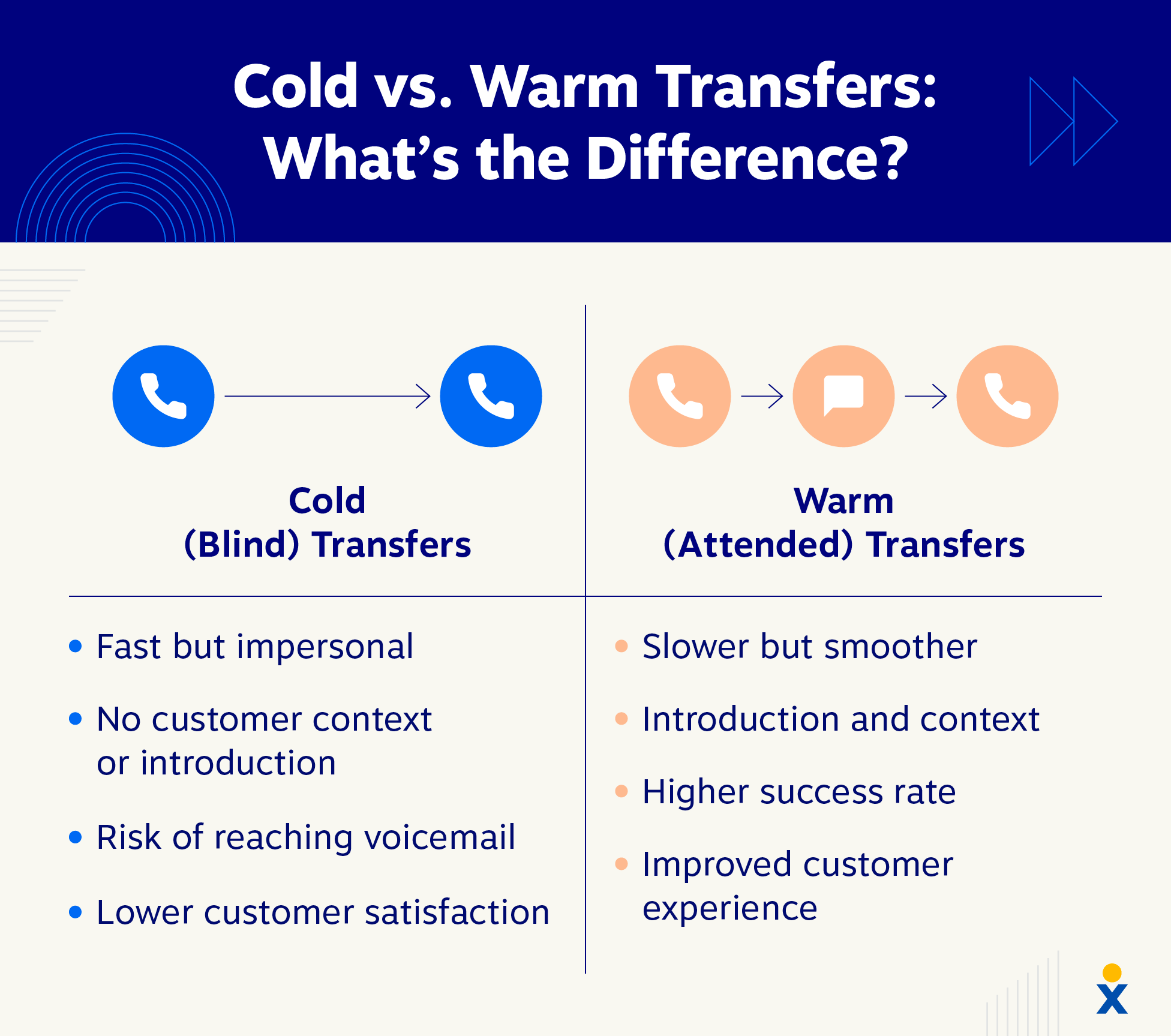
The important thing variations between chilly and heat transfers are within the degree of communication and preparation concerned earlier than routing the shopper to the receiving agent. Right here’s a breakdown specializing in the communication dynamics, relationship constructing, and affect on CX:
1. Communication dynamics
A chilly switch entails minimal prior interplay, typically resulting in impersonal exchanges, whereas a heat switch entails establishing rapport beforehand, fostering smoother transitions.
Consider a heat switch like having a useful pal at a celebration introducing you to everybody. The preliminary agent takes the time to determine some rapport, clarify your scenario to the receiving agent, after which easily join you. This fosters a extra welcoming and informative transition.
Think about going to that very same occasion, however your pal disappears into one other room minutes after you arrive. That’s the vibe of a chilly switch. There’s minimal prior interplay between the primary agent and the particular person you’re being transferred to. This typically results in impersonal exchanges the place you need to repeat your self and clarify every part once more.
2. Relationship constructing
A chilly switch lacks the chance for relationship improvement, whereas a heat switch permits for trust-building and personalised help, enhancing buyer engagement and satisfaction.

In heat transfers, when the preliminary agent introduces you by title and explains your scenario, this provides a private contact that places all events comfy.
Heat transfers:
- Assist clients really feel valued
- Show the model’s real curiosity in resolving your drawback
- Establishes belief and builds relationships
- Set the stage for a extra constructive and collaborative interplay with the specialist
A chilly switch doesn’t supply any alternative for relationship improvement. They might go away clients feeling like a ticket quantity slightly than a valued buyer.
Blind transfers:
- Lack of personalization on your clients
- Provide missed alternatives to determine buyer rapport
- Confuse and frustrate clients
Actually, lots of chilly transfers skip the human contact solely. When callers work together with an auto-attendant or interactive voice response (IVR) system, their calls are usually routinely routed primarily based on the choice they choose from a telephone menu. IVRs are efficient for quick help however might miss out on connecting with clients through human interactions.
3. Impression on buyer expertise
A chilly switch might end in frustration as a result of abrupt handoffs, whereas a heat switch fosters a seamless expertise, resulting in greater buyer loyalty and retention.
Abrupt handoffs with out context may be irritating. It’s possible you’ll really feel such as you’re ranging from scratch with every new agent. Chilly transfers affect the shopper expertise by can result in:
- Prolonged name occasions
- Lack of context
- Decreased confidence and loyalty
Heat transfers create a greater buyer expertise. Even small companies with restricted help brokers can use a VoIP telephone system with an auto-attendant or digital receptionist to assist make heat transfers simpler and extra environment friendly. The specialist you join with already has a fundamental understanding of your subject, permitting them to leap proper in and begin engaged on an answer.
Chilly Switch or Heat Switch: Which Is Higher for My Enterprise?
Selecting between the several types of transfers hinges on the character of your enterprise calls and priorities.

Chilly transferring a name is quicker service however not essentially good service. It can lead to decrease buyer satisfaction and a danger of sending them to voicemail, particularly for advanced points.
In distinction, a heat name switch enhances buyer satisfaction and effectivity by introducing the shopper and offering context and background data to the receiving specialist. Nonetheless, they require barely longer name dealing with time and depend upon agent availability.
For finest practices, practice your brokers on each switch strategies, spend money on know-how for seamless heat transfers, and monitor name heart metrics and KPIs to gauge their affect on buyer satisfaction and backbone charges. Aligning the fitting switch methodology along with your particular name varieties can optimize effectivity and create a extra customer-centric expertise.
Simplify Buyer Name Dealing with with Nextiva
Once we discuss heat switch vs. chilly switch in customer support, the fitting software program may help you set buyer satisfaction entrance and heart.
Nextiva’s contact heart answer makes it simple to seamlessly switch clients the place they have to be. Its user-friendly options, like easy-to-navigate interfaces, telephone tree, and name recording, make heat transfers a breeze.
And guess what? Nextiva’s omnichannel capabilities imply it’s not nearly calls — it will possibly deal with all buyer interactions easily, guaranteeing everybody stays comfortable.
The decision heart answer groups love.
Gross sales and help groups use Nextiva to ship a greater buyer expertise.
Chilly Switch vs. Heat Switch FAQs
Take a look at these regularly requested questions on chilly transfers vs. heat transfers.
Use a chilly name switch for easy inquiries or when your enterprise has excessive name volumes. Use a heat switch for advanced points, delicate subjects, or escalations.
Present brokers with a transparent course of for making name transfers simpler. Make name transfers simpler by briefly explaining the scenario to the receiving agent and introducing the shopper by title.
Heat transfers are usually most popular for buyer satisfaction as they’re extra private and environment friendly.
Heat and chilly transfers can happen on any communication channel the place a buyer interacts with a help agent. These channels embrace telephone calls, dwell chat, e-mail, SMS, social media, and extra.



