
Getty Photographs
A now-abandoned USB worm that backdoors related gadgets has continued to self-replicate for years since its creators misplaced management of it and stays energetic on 1000’s, probably thousands and thousands, of machines, researchers mentioned Thursday.
The worm—which first got here to mild in a 2023 publish revealed by safety agency Sophos—grew to become energetic in 2019 when a variant of malware often known as PlugX added performance that allowed it to contaminate USB drives routinely. In flip, these drives would infect any new machine they related to, a functionality that allowed the malware to unfold with out requiring any end-user interplay. Researchers who’ve tracked PlugX since not less than 2008 have mentioned that the malware has origins in China and has been utilized by varied teams tied to the nation’s Ministry of State Safety.
Nonetheless energetic in any case these years
For causes that aren’t clear, the worm creator deserted the one and solely IP handle that was designated as its command-and-control channel. With nobody controlling the contaminated machines anymore, the PlugX worm was successfully lifeless, or not less than one might need presumed so. The worm, it seems, has continued to reside on in an undetermined variety of machines that probably reaches into the thousands and thousands, researchers from safety agency Sekoia reported.
The researchers bought the IP handle and related their very own server infrastructure to “sinkhole” visitors connecting to it, which means intercepting the visitors to forestall it from getting used maliciously. Since then, their server continues to obtain PlugX visitors from 90,000 to 100,000 distinctive IP addresses each day. Over the span of six months, the researchers counted requests from almost 2.5 million distinctive IPs. These types of requests are commonplace for just about all types of malware and usually occur at common intervals that span from minutes to days. Whereas the variety of affected IPs does not immediately point out the variety of contaminated machines, the quantity nonetheless suggests the worm stays energetic on 1000’s, probably thousands and thousands, of gadgets.
“We initially thought that we’ll have a number of thousand victims related to it, as what we will have on our common sinkholes,” Sekoia researchers Felix Aimé and Charles M wrote. “Nevertheless, by organising a easy internet server we noticed a steady stream of HTTP requests various by way of the time of the day.”
They went on to say that different variants of the worm stay energetic by way of not less than three different command-and-control channels identified in safety circles. There are indications that one in all them might also have been sinkholed, nonetheless.
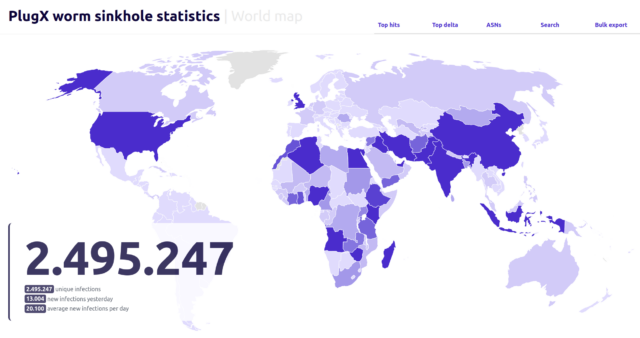
Because the picture under exhibits, the machines reporting to the sinkhole have broad geographic disbursement:
Sekoia
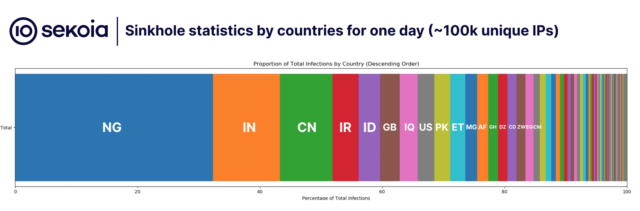
A pattern of incoming visitors over a single day appeared to point out that Nigeria hosted the biggest focus of contaminated machines, adopted by India, Indonesia, and the UK.
Sekoia
The researchers wrote:
Primarily based on that knowledge, it’s notable that round 15 international locations account for over 80% of the entire infections. It’s additionally intriguing to notice that the main contaminated international locations don’t share many similarities, a sample noticed with earlier USB worms reminiscent of RETADUP which has the very best an infection charges in Spanish spelling international locations. This means the likelihood that this worm might need originated from a number of affected person zeros in numerous international locations.
One clarification is that a lot of the greatest concentrations are in international locations which have coastlines the place China’s authorities has important investments in infrastructure. Moreover most of the most affected international locations have strategic significance to Chinese language navy aims. The researchers speculated that the aim of the marketing campaign was to gather intelligence the Chinese language authorities may use to realize these aims.
The researchers famous that the zombie worm has remained prone to takeover by any menace actor who positive factors management of the IP handle or manages to insert itself into the pathway between the server at that handle and an contaminated system. That menace poses fascinating dilemmas for the governments of affected international locations. They might select to protect the established order by taking no motion, or they might activate a self-delete command constructed into the worm that may disinfect contaminated machines. Moreover, in the event that they select the latter choice, they might elect to disinfect solely the contaminated machine or add new performance to disinfect any contaminated USB drives that occur to be related.
Due to how the worm infects drives, disinfecting them dangers deleting the reliable knowledge saved on them. Alternatively, permitting drives to stay contaminated makes it doable for the worm to start out its proliferation another time. Additional complicating the decision-making course of, the researchers famous that even when somebody points instructions that disinfect any contaminated drives that occur to be plugged in, it’s inevitable that the worm will reside on in drives that aren’t related when a distant disinfect command is issued.
“Given the potential authorized challenges that would come up from conducting a widespread disinfection marketing campaign, which includes sending an arbitrary command to workstations we don’t personal, we have now resolved to defer the choice on whether or not to disinfect workstations of their respective international locations to the discretion of nationwide Laptop Emergency Response Groups (CERTs), Regulation Enforcement Businesses (LEAs), and cybersecurity authorities,” the researchers wrote. “As soon as in possession of the disinfection checklist, we will present them an entry to start out the disinfection for a interval of three months. Throughout this time, any PlugX request from an Autonomous System marked for disinfection can be responded to with a removing command or a removing payload.”