It’s utterly despicable, however not within the least shocking, that scammers have turned to courting apps to search out their newest victims. The FBI lately printed a public service announcement that alerts courting app customers to a merciless rip-off making the rounds. Because the FBI explains, scammers ask folks they match with to confirm their id for security causes. They then share hyperlinks to websites able to stealing the sufferer’s cash and personal data.
Given the inherent dangers related to utilizing a courting app, this is usually a frighteningly efficient scheme. In spite of everything, just about everybody you meet on a courting app is a whole stranger. After all some customers need to know who they’re speaking to earlier than agreeing to satisfy up.
Right here’s how the scheme works so that you’ll know what to look out for. First, your match on Bumble, Hinge, or Tinder will try to determine a relationship shortly after which transfer the dialog off the courting app. They may then ask you to confirm your id, maybe as a result of they’d unhealthy experiences up to now or as a result of they need to be sure to aren’t a intercourse offender or serial killer. Subsequent, they may ship a hyperlink to a “free” on-line verification service.
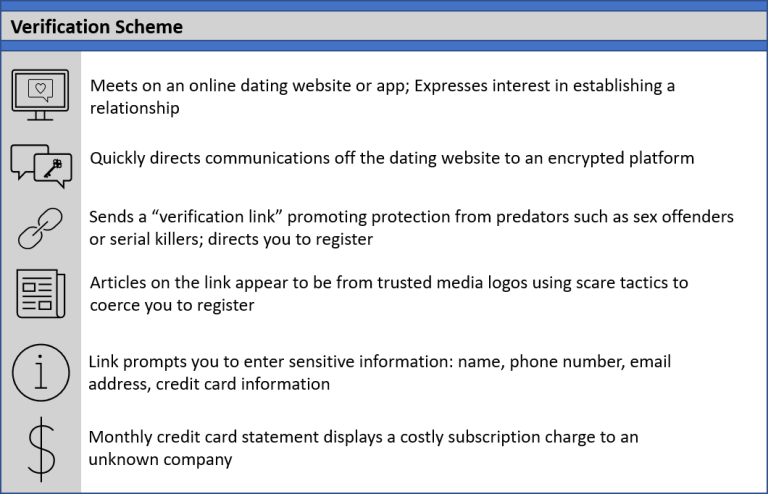
There are lots of such web sites, loads of which look actual at first look. Some even use clips of faux articles to advertise the web site’s legitimacy. The positioning will then ask you to enter your identify, cellphone quantity, electronic mail handle, and bank card quantity to confirm your id.
Regardless that these websites declare that you just don’t must pay for his or her companies, they redirect customers to “non-public, low-quality courting websites charging expensive month-to-month subscription charges.” You could not truly see it occur, however you will note a mysterious cost in your bank card.
Listed here are some ideas from the FBI to keep away from courting app scams like these going ahead:
- Keep away from clicking on hyperlinks, downloading information, or opening attachments from somebody you solely met on-line. Solely open attachments from recognized senders and scan all attachments for viruses, if potential.
- Keep away from shifting the dialog from a good courting web site’s messaging service, since many of those provide some security options.
- Report suspicious person profiles to the courting web site administrator and stop all contact with suspicious customers.
- Be cautious of somebody you solely met on-line professing their love shortly, expressing a necessity for assist, and/or attractive you with provocative photos and textual content matters. Fraudsters use social habits to deceive you and separate you out of your hard-earned cash.
- Don’t present delicate data to somebody you solely met on-line. Usually monitor your private monetary accounts for irregularities, comparable to recurring prices to unknown companies.
- Contact your bank card issuer/financial institution as quickly as potential when you uncover what seems to be a fraudulent transaction. Discover the opportunity of closing that bank card.
- Use one bank card with a restricted stability or think about using digital bank cards when subscribing to new on-line companies.
- Keep away from web sites that use scare ways to coerce you to register for a service. Search the supply of all data to find out its legitimacy.
- Keep up to date in regards to the newest fraud schemes by following the FBI IC3 web site or different monetary authorities web sites.
As tough as it may be to search out the right match on any courting app, all the time be vigilant when the dialog begins shifting in a route that appears suspicious.