

When Hubspot founders Brian Halligan and Dharmesh Shah conceived of their inbound advertising startup in 2004, they had been nonetheless graduate college students at MIT, and inbound advertising was not effectively understood. They had been in a position to develop that concept right into a profitable firm and ultimately went public in 2014. At present, the Boston-based firm has a market cap of over $30 billion.
There have been a number of parts that contributed to its favorable final result. The founders met at one of many premiere universities on this planet. That they had an thought, however they had been at a spot that nurtured concepts, in a area with skilled enterprise buyers who noticed the potential of the corporate. That gave them the power to boost capital, refine their plans and develop the corporate. All of that was potential as a result of they had been within the Boston space.
Each metropolis wants successful story like Hubspot, however Boston has many others together with iRobot, Wayfair, Acquia and Carbon Black, to call however a number of. Simply final 12 months, Klaviyo went public, including to the parade of startup success tales. Some had been purchased. Some went public. However all of them confirmed what’s potential for the many individuals who dream of constructing a profitable enterprise within the Boston space.
As these firms generate wealth for the founders, that in itself gives an angel funding system the place founders flush with money from their exits help a brand new era of founders, and on it goes on this virtuous wealth-generating cycle. What’s extra, these firms additionally produce different entrepreneurs, who go away and begin their very own firms, typically supported financially by their outdated bosses.
Within the lead as much as our Early Stage occasion happening in Boston on April 25, I spoke with some native Boston buyers and advisers to assist paint an image of what makes the Boston startup ecosystem so profitable.
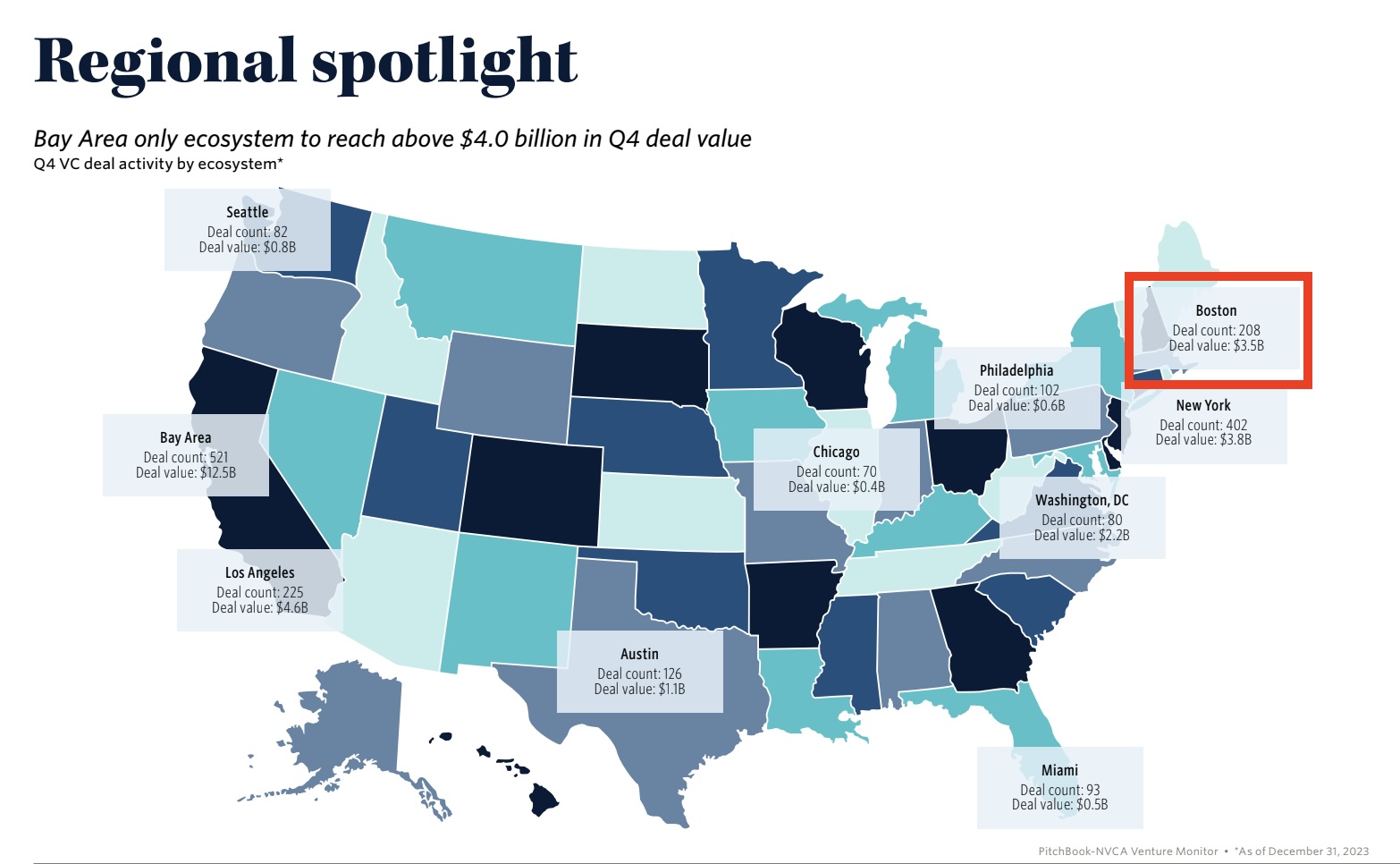
Though there are numerous dimensions to a profitable enterprise ecosystem, we have a tendency to have a look at the {dollars} invested to measure how effectively an space is doing. After we discuss Boston, town is simply a part of it. It’s actually a regional and even statewide perspective, however nevertheless you take a look at it, PitchBook counts enterprise funding {dollars} and places the Boston space in fourth place nationally in This autumn 2023. For a small metropolis in a small state, that’s fairly spectacular.
Be part of us at TechCrunch Early Stage in Boston this month to listen to Lily Lyman, Emily Knight, Rudina Seseri and different prime founders and buyers discuss important startup expertise. Register at this time!
Two of the opposite 4 are in California. San Francisco (to nobody’s shock) leads the best way, adopted by New York Metropolis, Los Angeles after which Boston. In This autumn 2023 Boston closed 208 offers, good for $3.5 billion in complete funding within the area.
How does Boston punch effectively above its weight on the subject of enterprise funding? Emily Knight is the president at The Engine Accelerator, an MIT spinoff that works with founders attempting to transform huge concepts from analysis labs into startups, generally often known as “powerful tech.” She says it’s a mix of things, beginning with the 35 faculties and universities in Boston alone. If you develop the map to incorporate the Boston metropolitan space, which incorporates Cambridge, that grows to 44 and provides Harvard, MIT and Tufts to the listing.
She says that these universities are breeding grounds for brand spanking new concepts. “There’s a variety of analysis and a variety of toddler innovation being translated into firms popping out of those universities,” she mentioned.
Picture Credit: PitchBook
Lily Lyman, a companion at Underscore VC, a Boston-based funding agency, says the college system is a giant motive her agency determined to launch in Boston. “It’s an enormous piece of the puzzle and actually, it’s a giant motive why we’re right here in Boston and why we’re bullish on Boston,” Lyman mentioned. In actual fact, a couple of third of Underscore’s portfolio got here straight out of the college system within the space, with a giant emphasis on Harvard, MIT and Northeastern.
That results in a second and associated aspect of pure expertise popping out of all these faculties. Rudina Seseri, managing director at Glasswing Ventures, says that expertise piece is so necessary and there’s no scarcity of STEM college students always flowing out of those faculties.
“For those who simply consider the uncooked expertise, and then you definately take a look at the place the AI and ML expertise is coming from, there may be an unbelievable pool of expertise, which matches up properly with my agency’s investments in enterprise and cybersecurity, and this area has finished very, very, very effectively in that regard,” she mentioned.
If you put all of it collectively, Lyman says, you get among the main constructing blocks for a profitable startup ecosystem. “The mix of the tech, the R&D that’s taking place right here and the expertise that’s coming by means of right here, it’s unparalleled,” she mentioned.
That’s to not say that Boston isn’t missing in sure facilities, particularly for younger founders, that the larger cities have in bunches. These limitations are effectively documented. There’s a scarcity of inexpensive housing, the general public transit system is crumbling, visitors is terrible, bars shut at 2 a.m. — and town, with its Yankee modesty, will not be good at selling itself.
Seseri says that whereas Boston could have some limitations, each metropolis has its personal points. She says what’s actually necessary is providing a spot the place startups can thrive. “What we are able to have an effect on is how entrepreneurial-friendly and supportive we’re. So from providing free areas to increasingly more areas for incubators and accelerators and discovery, to offering entry to clients and to platforms that may speed up innovation,” she mentioned.
There are certainly numerous incubators and accelerator applications like Mass Problem, Greentown Labs, IDEA and Roxbury Innovation Heart, amongst others providing a spot to nurture early-stage concepts.
And what Boston could lack in nightlife, it absolutely makes up for in mind energy and lengthy historical past of startup success. As Seseri says, success begets success.
“I might say greater than something we have to help extra founders. We have to help extra successes. We’d like these successes in order that the wheel continues spinning at a quicker price,” she mentioned.



