The bleeding edge: At the moment, the very best high quality footage come from shows with OLED screens. The blackest blacks and the brilliant, vibrant colours it produces are unmatched. The expertise comes at a premium, however a stroll by way of the native division retailer exhibits that costs are starting to come back down. As costs begin dipping for the newest electronics, we start questioning in regards to the subsequent era.
Micro-LEDs are in line to exchange OLEDs however want one other half decade or so of improvement earlier than commercialization. Noctiluca notes that micro-LED tech can be excellent for clear screens and shows seen outside in daylight, like cell telephones and digital billboards. Nonetheless, there’s one other show tech referred to as QDEL that’s a lot nearer.
Ars Technica opines that QDEL, or quantum dot electroluminescent, may be the subsequent bleeding-edge tech for high-end televisions, displays, and devices with screens. Also called NanoLED, QDEL is an emissive expertise that doesn’t require a backlight – electroluminescent quantum dots emit mild immediately. These Q-dots are the identical as these in high-end QD-OLEDs however are brighter, cheaper, and extra immune to burn-in.
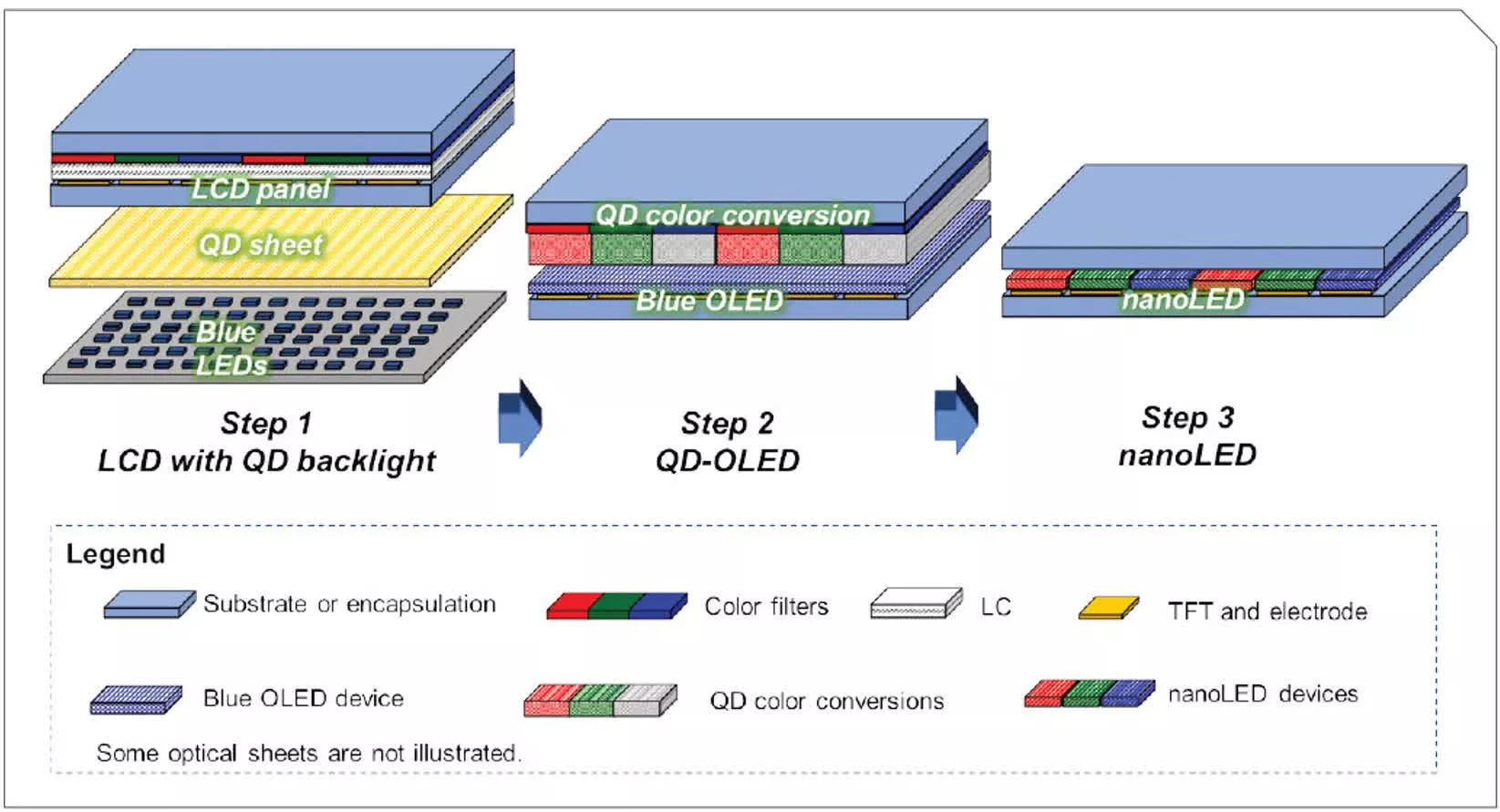
Moreover, QDEL expertise needs to be obtainable throughout the subsequent few years, whereas micro-LED will not be prepared for shoppers till round 2030. Quantum dot provider Nanosys has been engaged on the tech for a number of years. Its potential model identify is NanoLED, but it surely has passed by different names throughout improvement, together with QD-EL, QD-LED, EL-QD, and QLED, though Samsung trademarked the latter in 2016, the 12 months earlier than launching its QLED branded TVs.
Nanosys has tentatively focused 2026 as its window for taking the expertise industrial, however as a provider, it’s as much as producers like Sharp, Sony, and LG to benefit from it. So we could not see comsumer units till later.
“With regards to client devices, [I expect] QDEL will most affect TVs, PC shows, and the automotive trade,” Omdia Senior Analysis Director David Hsieh advised Ars Tecnica. “If commercialized and mass-produced, QDEL can have a cost-to-performance ratio higher than that of OLED, however it might nonetheless wrestle to compete with LCD-LED on a value foundation.”
As an OEM provider, Nanosys does not produce shows, so prototypes that make the most of QDEL are scarce, making the corporate’s 2026 timeframe considerably formidable. Nonetheless, it has launched some beta-level QDEL tech to permit a handful of firms to experiment.
Digital Tendencies went to CES 2024 in January, particularly on the lookout for QDEL prototypes. It took some time, and DT correspondent Caleb Denison was about to depart Las Vegas earlier than getting a name from Sharp Show reps. They’d heard he was on the lookout for QDEL shows and invited him to view two “secret” prototypes of their CES “backroom” (video above).
Viewing any show in a video is just not excellent for getting a good suggestion of the standard, and QDEL is not any exception. Nonetheless, Denison was impressed and excited by Sharp’s small 12.3-inch prototype (proven) and its top-secret 30-inch QDEL show (hidden). He additionally stated that Sharp could have some developments to point out off later this 12 months.
Picture credit score: PlasmaChem