
Getty Photos
On Tuesday, Microsoft introduced a brand new, freely accessible light-weight AI language mannequin named Phi-3-mini, which is easier and cheaper to function than conventional giant language fashions (LLMs) like OpenAI’s GPT-4 Turbo. Its small measurement is good for operating regionally, which may carry an AI mannequin of comparable functionality to the free model of ChatGPT to a smartphone without having an Web connection to run it.
The AI subject sometimes measures AI language mannequin measurement by parameter rely. Parameters are numerical values in a neural community that decide how the language mannequin processes and generates textual content. They’re realized throughout coaching on giant datasets and primarily encode the mannequin’s data into quantified kind. Extra parameters typically enable the mannequin to seize extra nuanced and complicated language-generation capabilities but additionally require extra computational sources to coach and run.
Among the largest language fashions in the present day, like Google’s PaLM 2, have a whole bunch of billions of parameters. OpenAI’s GPT-4 is rumored to have over a trillion parameters however unfold over eight 220-billion parameter fashions in a mixture-of-experts configuration. Each fashions require heavy-duty knowledge middle GPUs (and supporting techniques) to run correctly.
In distinction, Microsoft aimed small with Phi-3-mini, which comprises solely 3.8 billion parameters and was educated on 3.3 trillion tokens. That makes it excellent to run on client GPU or AI-acceleration {hardware} that may be present in smartphones and laptops. It is a follow-up of two earlier small language fashions from Microsoft: Phi-2, launched in December, and Phi-1, launched in June 2023.
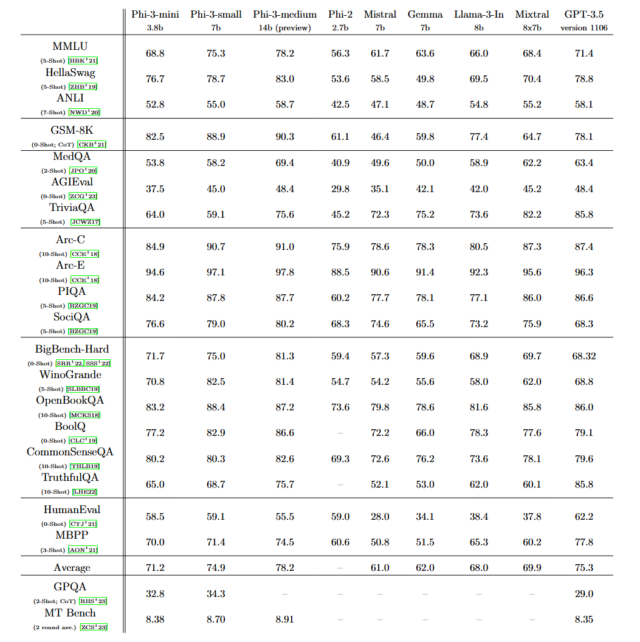
Phi-3-mini includes a 4,000-token context window, however Microsoft additionally launched a 128K-token model known as “phi-3-mini-128K.” Microsoft has additionally created 7-billion and 14-billion parameter variations of Phi-3 that it plans to launch later that it claims are “considerably extra succesful” than phi-3-mini.
Microsoft says that Phi-3 options total efficiency that “rivals that of fashions similar to Mixtral 8x7B and GPT-3.5,” as detailed in a paper titled “Phi-3 Technical Report: A Extremely Succesful Language Mannequin Regionally on Your Cellphone.” Mixtral 8x7B, from French AI firm Mistral, makes use of a mixture-of-experts mannequin, and GPT-3.5 powers the free model of ChatGPT.
“[Phi-3] appears like it’ll be a surprisingly good small mannequin if their benchmarks are reflective of what it will probably really do,” stated AI researcher Simon Willison in an interview with Ars. Shortly after offering that quote, Willison downloaded Phi-3 to his Macbook laptop computer regionally and stated, “I bought it working, and it is GOOD” in a textual content message despatched to Ars.
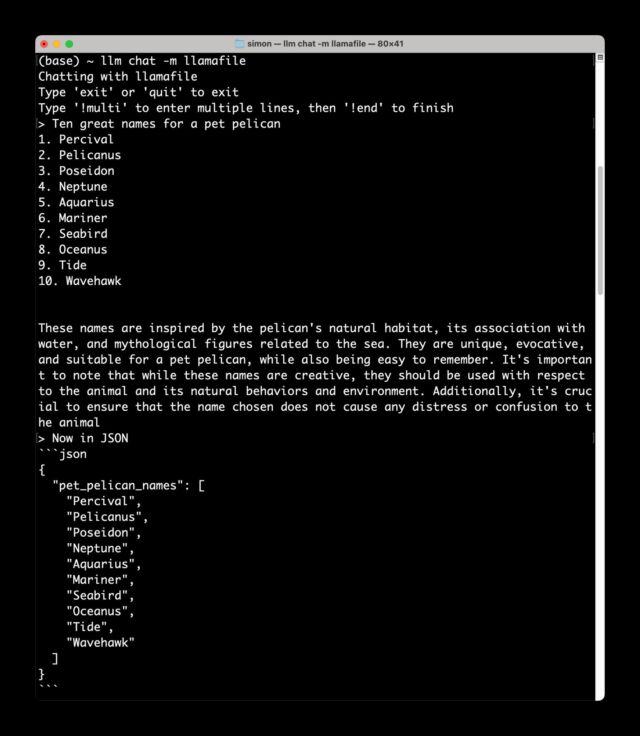
Simon Willison
“Most fashions that run on a neighborhood system nonetheless want hefty {hardware},” says Willison. “Phi-3-mini runs comfortably with lower than 8GB of RAM, and might churn out tokens at an affordable pace even on only a common CPU. It is licensed MIT and may work effectively on a $55 Raspberry Pi—and the standard of outcomes I’ve seen from it to this point are akin to fashions 4x bigger.“
How did Microsoft cram a functionality just like GPT-3.5, which has at the least 175 billion parameters, into such a small mannequin? Its researchers discovered the reply by utilizing fastidiously curated, high-quality coaching knowledge they initially pulled from textbooks. “The innovation lies solely in our dataset for coaching, a scaled-up model of the one used for phi-2, composed of closely filtered net knowledge and artificial knowledge,” writes Microsoft. “The mannequin can be additional aligned for robustness, security, and chat format.”
A lot has been written in regards to the potential environmental affect of AI fashions and datacenters themselves, together with on Ars. With new strategies and analysis, it is attainable that machine studying specialists could proceed to extend the aptitude of smaller AI fashions, changing the necessity for bigger ones—at the least for on a regular basis duties. That may theoretically not solely lower your expenses in the long term but additionally require far much less power in combination, dramatically reducing AI’s environmental footprint. AI fashions like Phi-3 could also be a step towards that future if the benchmark outcomes maintain as much as scrutiny.
Phi-3 is straight away accessible on Microsoft’s cloud service platform Azure, in addition to by means of partnerships with machine studying mannequin platform Hugging Face and Ollama, a framework that enables fashions to run regionally on Macs and PCs.