


Getty Pictures
For those who’re utilizing Amazon Internet Providers and your S3 storage bucket may be reached from the open internet, you’d do effectively to not decide a generic identify for that area. Keep away from “instance,” skip “change_me,” do not even go along with “foo” or “bar.” Another person with the identical “change this later” pondering can value you a MacBook’s price of money.
Ask Maciej Pocwierz, who simply occurred to select an S3 identify that “one of many well-liked open-source instruments” used for its default backup configuration. After organising the bucket for a shopper venture, he checked his billing web page and located almost 100 million unauthorized makes an attempt to create new recordsdata on his bucket (PUT requests) inside in the future. The invoice was over $1,300 and counting.
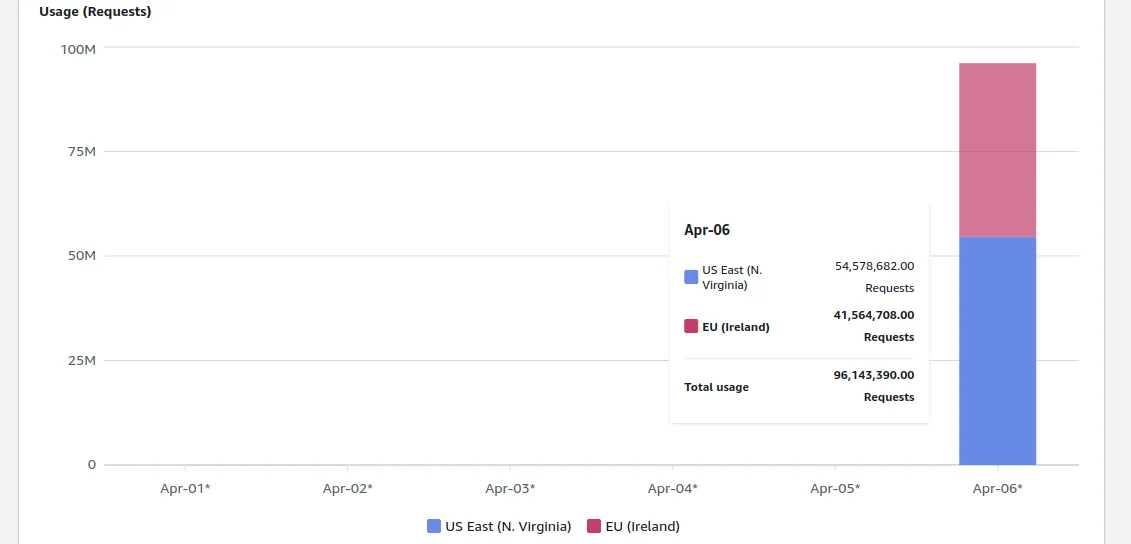
Nothing, nothing, nothing, nothing, nothing … almost 100 million unauthorized requests.
“All this really occurred only a few days after I ensured my shopper that the value for AWS companies can be negligible, like $20 at most for the complete month,” Pocwierz wrote over chat. “I defined the scenario could be very uncommon however it undoubtedly seemed as if I did not know what I am doing.”
Pocwierz declined to call the open supply instrument that inadvertently bum-rushed his S3 account. In a Medium put up concerning the matter, he famous a unique drawback with an unfortunate default backup. After turning on public writes, he watched as he collected greater than 10GB of information in lower than 30 seconds. Different folks’s knowledge, that’s, they usually had no concept that Pocwierz was accumulating it.
A few of that knowledge got here from firms with prospects, which is a part of why Pocwierz is holding the specifics underneath wraps. He wrote to Ars that he contacted among the firms that both tried or efficiently backed up their knowledge to his bucket, and “they utterly ignored me.” “So now as a substitute of getting this mounted, their knowledge continues to be in danger,” Pocwierz writes. “My lesson is that if I ever run an organization, I’ll undoubtedly have a bug bounty program, and I’ll deal with such warnings severely.”
As for Pocwierz’s accounts, each S3 and financial institution, it principally ended effectively. An AWS consultant reached out on LinkedIn and canceled his invoice, he mentioned, and was informed that anyone can request refunds for extreme unauthorized requests. “However they did not explicitly say that they’ll essentially approve it,” he wrote. He famous in his Medium put up that AWS “emphasised that this was finished as an exception.”
In response to Pocwierz’s story, Jeff Barr, chief evangelist for AWS at Amazon, tweeted that “We agree that prospects shouldn’t must pay for unauthorized requests that they didn’t provoke.” Barr added that Amazon would have extra to share on how the corporate may forestall them “shortly.” AWS has a short explainer and make contact with web page on surprising AWS prices.
The open supply instrument did change its default configuration after Pocwierz contacted them. Pocwierz steered to AWS that it ought to limit anybody else from making a bucket identify like his, however he had but to listen to again about it. He suggests in his weblog put up that, past random dangerous luck, including a random suffix to your bucket identify and explicitly specifying your AWS area may help keep away from large prices just like the one he narrowly dodged.



